Stamp Duty and Registration Charges in Nepal: A Complete Breakdown
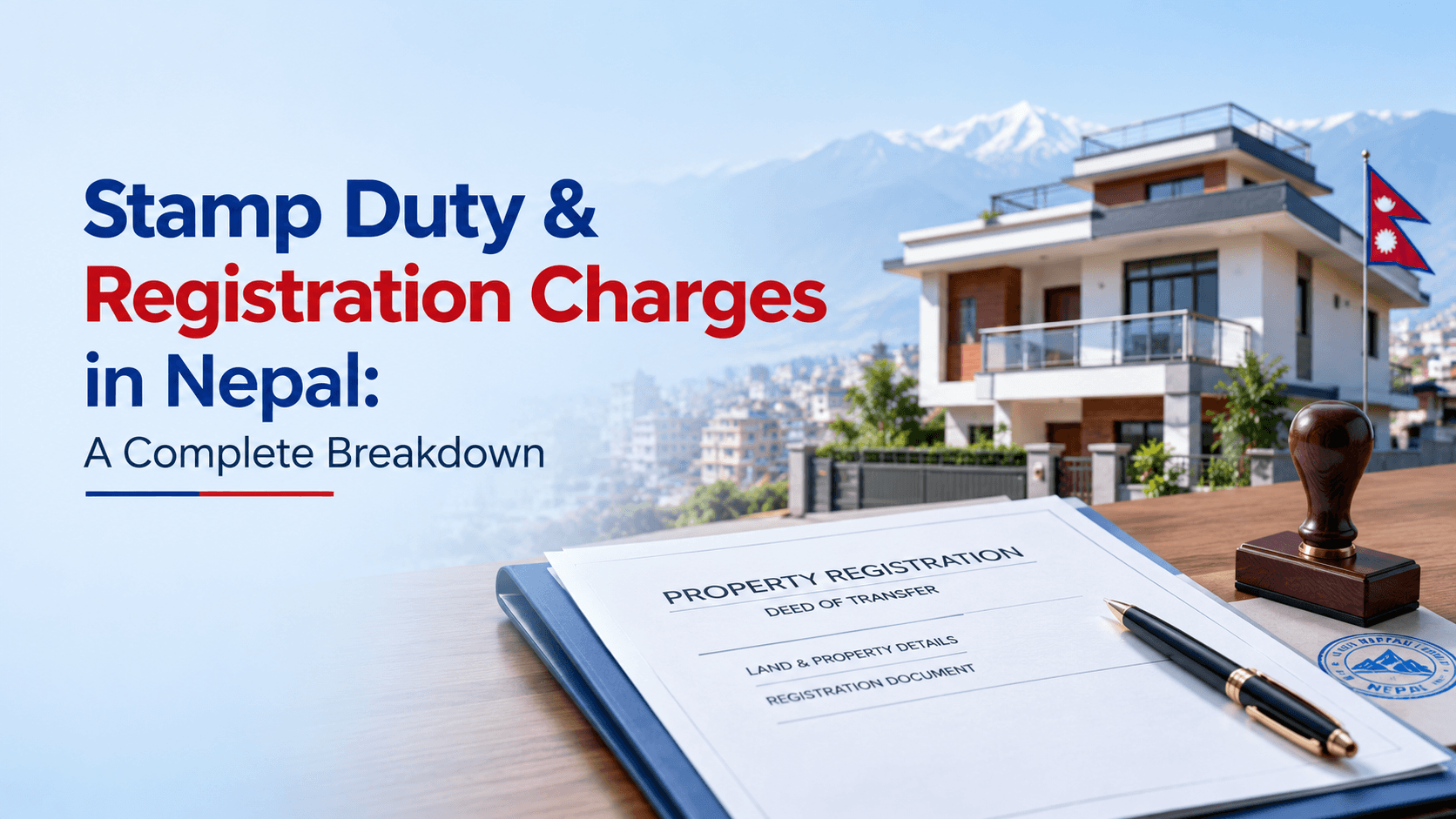
Buying or selling property in Nepal costs more than the price on the deed. The extra bill is the registration charge you pay at the Land Revenue Office, plus the seller’s capital gains tax. On a typical Kathmandu deal, budget somewhere between 6 and 9 percent of the property value for these charges combined. The buyer usually carries the registration fee. The seller usually carries the capital gains tax.
Here is the short version. The registration fee (people call it malpot dastur) runs about 4 to 6 percent of the declared value in most places. It lands near 5 percent for a metropolitan city inside Kathmandu Valley. It is set by your province, not the federal government, so the exact rate depends on where the land sits. Women buyers get a 25 percent discount on that fee. Sellers pay capital gains tax of 7.5 or 10 percent on their profit, depending on how long they owned the property.
That is the whole picture in two paragraphs. The rest of this guide breaks down each charge, who pays it, and how to run the numbers for your own deal.
Quick answer: what you pay at registration

Here is the full stack of charges on a standard property sale in Nepal, using Kathmandu Valley as the example.
| Charge | Who pays | Rough rate |
|---|---|---|
| Registration fee (malpot dastur) | Buyer | About 5 percent of declared value in a Valley metropolitan city; 4 to 6 percent elsewhere |
| Capital gains tax | Seller | 7.5 percent (held over 5 years) or 10 percent (held 5 years or less), on the gain only |
| Ward office letter, deed drafting, lawyer | Buyer, mostly | NPR 5,000 to 25,000 |
| Revenue stamp, photocopies, witnesses | Split | A few thousand rupees |
There is no separate “stamp duty” line in Nepal the way there is in India. The deed sits on a small fixed-cost revenue stamp, and the registration fee does the job that stamp duty does elsewhere. So when people say “stamp duty in Nepal,” they almost always mean the registration fee.
Is stamp duty the same as the registration fee?
In practice, yes. Nepal does not charge a percentage-based stamp duty on top of registration. You buy a revenue stamp (ticket) for the deed, and that is a nominal fixed cost. The percentage charge that hurts your wallet is the registration fee, calculated on the value of the property.
This trips up a lot of first-time buyers who read Indian property guides and expect two separate percentage charges. In Nepal, there is really one big one: the registration fee. Then the seller has capital gains tax. Everything else is small.
Who sets the registration fee, and why rates differ
The registration fee is a provincial tax. Each of Nepal’s seven provinces sets its own schedule through its annual Finance Act. This single fact explains most of the confusion you will find online. A rate copied from a Lumbini or Gandaki blog will not match what you actually pay in Kathmandu.
For Kathmandu Valley, the schedule sits in the Bagmati Province Finance Act. As of fiscal year 2083/84 (2026/27), the Bagmati rates work out roughly like this:
- Metropolitan city inside Kathmandu Valley (Kathmandu, Lalitpur): around 5 percent (some sources cite 5.3 percent)
- Municipality inside the Valley (Bhaktapur, Kirtipur, Tokha, Budhanilkantha, Madhyapur Thimi): a little under 5 percent
- Metropolitan city outside the Valley: close to 5 percent
- Sub-metropolitan city: around 4.5 to 4.7 percent
- Municipality outside the Valley: around 4.5 percent
- Rural municipality (gaupalika): around 3 percent
Two takeaways. First, the fee is lower in rural areas and higher in the big cities. Second, because rates change with each provincial budget, you should confirm the current figure with your local Land Revenue Office before you sign anything. The office is now often called the Bhumi Prashasan Karyalaya (Land Administration Office), but most people still say Malpot.
Do apartments and flats get a cheaper rate?
You will hear that apartments register at 1 percent. Be careful with that claim. The Bagmati schedule lists sale deeds, group-housing flats, and group-housing house-and-land at the same rate. In other words, a flat inside Kathmandu Metropolitan registers at the same percentage as a plot of land of the same declared value.
If a builder or agent tells you flats get a special 1 percent rate, ask them to point to the exact line in the current provincial Finance Act. Do not budget around a discount you cannot confirm at the counter.
The women buyer discount is real and large
Nepal gives a genuine discount when property is registered in a woman’s name. Under the Bagmati schedule, a deed transferring ownership to a woman gets a 25 percent cut on the registration fee. Single women often get more (commonly cited at 35 percent), and rural municipalities offer an extra concession too (usually cited at 30 to 35 percent). The exact figure depends on the province and the year, so confirm it locally.
Let us put a number on it. On an NPR 1 crore property inside Kathmandu Metropolitan, a 5 percent fee is NPR 5,00,000. A 25 percent discount saves NPR 1,25,000. That is real money for one signature.
A joint deed in a husband’s and wife’s name usually still qualifies for the woman’s concession. Only one concession applies per deed. Senior citizens and parentless minors also get relief under the same rule in Bagmati. Suppose your family is deciding whose name goes on the lalpurja. If the choice is open, registering in a woman’s name is often the cheapest single move you can make at the Malpot counter.
The “Bagmati Sabhyata Kosh” surcharge: verify before you believe it
Here is a claim you will see on several Nepali property and law-firm blogs: that Kathmandu Valley property carries an extra 5 percent “Bagmati Sabhyata Kosh” (civilization fund) surcharge on top of the registration fee.
Treat this with caution. At least one detailed review of the actual Bagmati Province Finance Act text reports that no such civilization fund and no Valley-specific surcharge appears in the Act. The likely source of the confusion is simple. The Valley rate is genuinely a touch higher than the rest of the province. That premium is built into the base rate, not bolted on as a separate line.
Because sources disagree, do not assume you will pay this surcharge, and do not assume you will not. When you get your fee voucher at the counter, ask the officer to identify every line and which rule authorizes it. That habit protects you from both a surprise charge and an invented one.
How the government values your property
Malpot does not simply accept the price written on the deed. Every fiscal year, a district committee chaired by the Chief District Officer publishes a minimum valuation for each ward, locality, and road type. This is the sarkari mulyankan (government valuation).
The rule is straightforward. The registration fee and capital gains tax are calculated on whichever is higher: the declared transaction price or the government minimum valuation. If you declare a price below the minimum, Malpot uses the minimum and will not register the deed below that floor.
Government minimum valuations usually sit well below real market prices, often around 30 to 40 percent of what a plot actually trades for. For Kathmandu Metropolitan, recent minimum valuations have ranged widely. Outer wards sit at a few lakh rupees per aana. Prime commercial stretches like Durbar Marg and New Road run to tens of lakhs per aana. Because the official value is lower than market, your registration fee is often calculated on a smaller number than the price you actually paid. That is one reason the effective cost sometimes feels lower than the headline percentage suggests.
Capital gains tax: the seller’s bill

When you sell property in Nepal, you pay capital gains tax on your profit, not on the full sale price. Malpot withholds this at the time of registration. For individuals, as of fiscal year 2083/84, the rates are:
- Held for 5 years or less: 10 percent on the gain
- Held for more than 5 years: 7.5 percent on the gain
These rates went up under the Finance Act 2083, effective 16 July 2026 (Shrawan 1, 2083). Older articles still quoting 5 percent or 7.5 percent are describing the previous fiscal year. So if you are selling in 2026 or later, use the higher figures and double-check the current year’s budget.
A few rules that matter on registration day:
- The gain is your selling price minus your original purchase price minus allowable expenses. Allowable expenses can include documented renovation, brokerage, and legal costs. Keep every receipt.
- Capital gains tax generally applies to transactions above NPR 10 lakh.
- Transfers to a spouse, to children, or by inheritance are usually exempt.
- A long-held primary residence can qualify for exemption in some cases. Confirm your situation with the office or a tax advisor.
- For companies and firms, the treatment is different and often higher. This guide covers individuals.
One receipt matters more than the rest: the Malpot receipt from when you originally bought the property. It proves your purchase price. Lose it, and Malpot may fall back on an old, low minimum valuation as your cost, which inflates your taxable gain and your tax. Scan it and file it with your lalpurja the day you buy.
A worked example: NPR 1 crore plot in Kathmandu
Say you buy a plot inside Kathmandu Metropolitan for a declared NPR 1 crore. You are a male buyer. The seller bought it three years ago for NPR 70 lakh.
Buyer side:
| Item | Amount (NPR) |
|---|---|
| Registration fee (5 percent of 1 crore) | 5,00,000 |
| Ward office recommendation letter | about 1,000 |
| Lawyer and deed drafting | about 10,000 |
| Buyer total | about 5,11,000 |
Seller side:
| Item | Amount (NPR) |
|---|---|
| Gain (1 crore minus 70 lakh minus 50,000 brokerage) | 29,50,000 |
| Capital gains tax at 10 percent (held under 5 years) | 2,95,000 |
| Seller total | 2,95,000 |
Combined, that is roughly NPR 8,06,000 on a 1 crore deal, or about 8 percent of the headline price. Change three things and the picture shifts:
- If the seller held over 5 years, capital gains tax drops to 7.5 percent, or NPR 2,21,250.
- If the buyer is a woman, the 25 percent registration discount saves NPR 1,25,000.
- Do both, and the combined cost falls closer to 6 percent.
Remember that this example uses the declared value. If the government minimum valuation on the plot is lower than 1 crore and you declare the true price, your fee is on the higher number. If you declared the minimum instead, your fee would be smaller, but that path carries real risk, covered next.
The under-declaration trap
Because the government minimum valuation runs well below market, many buyers and sellers agree to declare a value somewhere between the minimum and the real price. It cuts the registration fee and the capital gains tax at the same time. It is common. It is also risky.
The downsides are getting sharper as records go digital:
- Penalties on evaded tax can be steep, and fraudulent declaration can invite prosecution.
- Malpot will not accept a lower declared value than a previously registered one. So an under-declaration today becomes the ceiling that limits your sale value tomorrow.
- Malpot increasingly cross-checks bank records, citizenship-linked filings, and PAN details.
There is also a practical trap for the buyer. If you under-declare now, your low recorded price becomes your cost basis when you sell later. That can mean a much bigger capital gains bill down the road. The short-term saving can cost you more than it saves.
Other charges and documents to budget for
Beyond the two big charges, registration day involves several small ones:
- Tax clearance receipt (tiro rasid): the seller must have paid annual land tax up to date.
- Ward office recommendation letter: around NPR 1,000.
- Char killa report: the boundary description of the plot.
- Roka phukuwa: clearance of any freeze on the land before registration can go through. If the plot is mortgaged or under dispute, this must lift first.
- Revenue stamps, photocopies, photos, and two witnesses per side.
None of these is large on its own, but together they add a few thousand rupees that nobody quotes upfront. For the full document checklist and the step-by-step flow at the office, see the Basobaas guide on the property registration process in Nepal.
How to reduce your registration costs, legally
You cannot dodge the fee, but you can plan around it:
- Register in a woman’s name if the family choice is open. The 25 percent discount is the biggest legal saving available.
- Buy in a municipality or rural area rather than a metropolitan city if the location works for you. The percentage is lower.
- Keep every receipt from your purchase and any renovation. These lower the seller’s capital gains tax when you eventually sell.
- Check the current-year rate before you finalize your budget. Provincial rates move with each annual Finance Act.
- Verify the land is free of any roka before you pay a deposit, so you do not get stuck mid-registration. The Basobaas guides on checking disputed land and spotting property scams walk through the checks.
Frequently asked questions
How much is the property registration fee in Kathmandu in 2026? For a sale deed inside a Kathmandu Valley metropolitan city, the registration fee is around 5 percent of the declared value (some sources cite 5.3 percent). Valley municipalities are a little lower, and rural municipalities are around 3 percent. The rate is set by the Bagmati Province Finance Act and changes each fiscal year, so confirm the current figure at your Land Revenue Office.
Is there a separate stamp duty in Nepal? Not as a percentage. Nepal charges a small fixed-cost revenue stamp on the deed, and the registration fee acts as the main transfer tax. When people say “stamp duty in Nepal,” they usually mean the registration fee.
Do women really pay less to register property? Yes. A deed registered in a woman’s name gets a 25 percent discount on the registration fee in Bagmati, with larger concessions for single women and in rural municipalities. On a 1 crore Kathmandu property, that 25 percent saves about NPR 1,25,000.
Who pays the registration fee, buyer or seller? By custom, the buyer pays the registration fee, and the seller pays the capital gains tax. In practice the parties can negotiate. In a slow market, sellers sometimes absorb part of the buyer’s fee to keep a deal alive.
How much capital gains tax does the seller pay? For individuals, it is 10 percent of the gain if the property was held 5 years or less, and 7.5 percent if held longer. These rates rose under the Finance Act 2083, effective 16 July 2026. The tax applies to gains on transactions above NPR 10 lakh and is withheld at registration.
Can I save by declaring a lower price to Malpot? It cuts your fee today, but the risks are serious: penalties, a locked-in low ceiling for your future sale, and a bigger capital gains bill later because your recorded cost is low. With records going digital, under-declaration is riskier than it used to be.
The bottom line
The registration charge is the big number most Nepali buyers underestimate. Plan for roughly 4 to 6 percent of the property value as the buyer, closer to 5 percent inside Kathmandu Valley, and remember the seller has a separate capital gains bill on top. Rates are provincial and change every year, so the smartest move is to confirm the current figure at your Land Revenue Office before you commit.
When you are ready to start the search, you can browse verified property listings on Basobaas or list your own place for free. And if you want to sanity-check the money side first, the Basobaas EMI calculator and land unit converter are good places to run your numbers.
Rates and rules in this guide reflect the situation as of 2026 and can change with each provincial and federal budget. This is general information, not legal or tax advice. Confirm the current figures for your property with your local Land Revenue Office or a qualified advisor.
Latest Posts
Fresh reads from Basobaas