Gift Deed vs Sale Deed in Nepal: Which Is Better for Transferring Property

Thinking about moving land or a house into someone else’s name? You have two main tools in Nepal. A gift deed (Bakaspatra, sometimes called Halibakas at the land office) and a sale deed (Rajinama). They both end with a new Lalpurja in the receiver’s name. But they are not the same thing, and picking the wrong one can cost you money or start a family fight.
Quick answer: Use a gift deed (Bakaspatra) when you are handing property to a close family member for free, like a parent passing land to a child. Gifts between close blood relatives usually avoid capital gains tax, though you still pay the registration fee. Use a sale deed (Rajinama) when money is changing hands, or when the receiver is not family. A sale is a normal purchase, so capital gains tax applies to the seller’s profit, and the buyer pays the registration fee. That is the short version. The details below decide the actual rupees.
This guide breaks down both options in plain terms. We cover the legal basis, the paperwork, the fees, the tax, and the traps people fall into. Rates and rules can change with each year’s budget, so treat the numbers here as a guide and confirm with your local Malpot (Land Revenue Office) before you sign anything.
What Is a Gift Deed (Bakaspatra) in Nepal?

A gift deed is a legal document that transfers ownership of property from one person to another without any payment. The person giving is the donor. The person receiving is the donee. There is no price. The transfer runs on the donor’s free will alone.
In law, this is a Bakaspatra under Chapter 10 of the Muluki Civil Code, 2074. Once the deed is properly signed, accepted, and registered at the Land Revenue Office, ownership passes for good. The donor loses all rights over that property.
Nepali families use gift deeds a lot. Parents pass land to children. A husband adds a wife to the title. People use it for succession planning while they are still alive, so heirs do not fight later. It feels informal because it happens inside the family. It is not informal at all. It is a binding transfer that is hard to undo.
There are a few kinds of gift deed you should know about:
- Immediate gift. Ownership passes right away once the deed is executed and accepted.
- Gift effective on death (शेषपछिको बकसपत्र). The transfer takes effect only after the donor dies. The donor keeps control while alive.
- Conditional gift. The gift depends on a condition being met. The condition must be lawful.
- Family gift. A gift between parents, children, spouses, or other close relatives. Same legal rules, very common use.
What Is a Sale Deed (Rajinama) in Nepal?

A sale deed is the document used when property is sold. Money moves from buyer to seller. The seller signs over the land or house, and in return receives an agreed price. This is a Rajinama, and it is the standard instrument for a normal property purchase.
The process runs through the same Land Revenue Office. Both parties appear, the deed is prepared and signed in front of the staff, fees and taxes are paid, and a fresh Lalpurja is issued in the buyer’s name. If you have ever bought land in Nepal, you have done a Rajinama.
The key legal feature is consideration. That is the lawyer’s word for payment. A sale needs a price. A gift needs the absence of one. That single difference drives almost everything else, including the tax you pay.
Gift Deed vs Sale Deed: The Core Difference
Here is the heart of it. A gift is a transfer for love and affection. A sale is a transfer for money. The tax office treats them very differently.
When you sell, the government looks at your profit. You bought the land for some amount years ago. You are selling it for more now. That gain is taxable. This is capital gains tax, and the seller pays it.
When you gift property to a close relative, there is no sale price and no profit to tax. So capital gains tax is generally waived for gifts between direct blood relatives. You still pay the registration fee, but you skip the capital gains bill. That is the main reason families choose a gift deed over a paper sale.
| Feature | Gift Deed (Bakaspatra) | Sale Deed (Rajinama) |
|---|---|---|
| Payment involved | None | Agreed price |
| Typical use | Family transfer, succession | Normal purchase or sale |
| Capital gains tax | Usually exempt for close relatives | Applies to seller’s gain |
| Registration fee | Yes, paid at Malpot | Yes, paid by buyer |
| Who usually pays fees | Often the donee (receiver) | The buyer |
| Reversible? | Hard to reverse, limited grounds | Final once registered |
| Best when | Giving to family for free | Money is changing hands |
What Documents Do You Need?
For either deed, both people go to the Land Revenue Office for the district where the property sits. The paperwork overlaps a lot. Here is what to bring for a gift deed transfer:
- The original Lalpurja (title deed) of the property.
- Citizenship certificates of both donor and donee, originals and copies.
- The land parcel map (Napi Naksha) showing boundaries.
- Tax clearance certificate from the local municipality, showing land taxes are paid.
- A relationship certificate, since gifts between family need proof of the relationship.
- PAN cards where the value crosses the threshold that requires them.
- Recent photographs of both parties.
- Revenue stamps.
For a sale deed (Rajinama), the list is almost identical. You swap the relationship certificate for the sale agreement (Bainapatra) if a deposit deal was signed earlier. Corporate buyers or sellers add company registration papers and a board resolution.
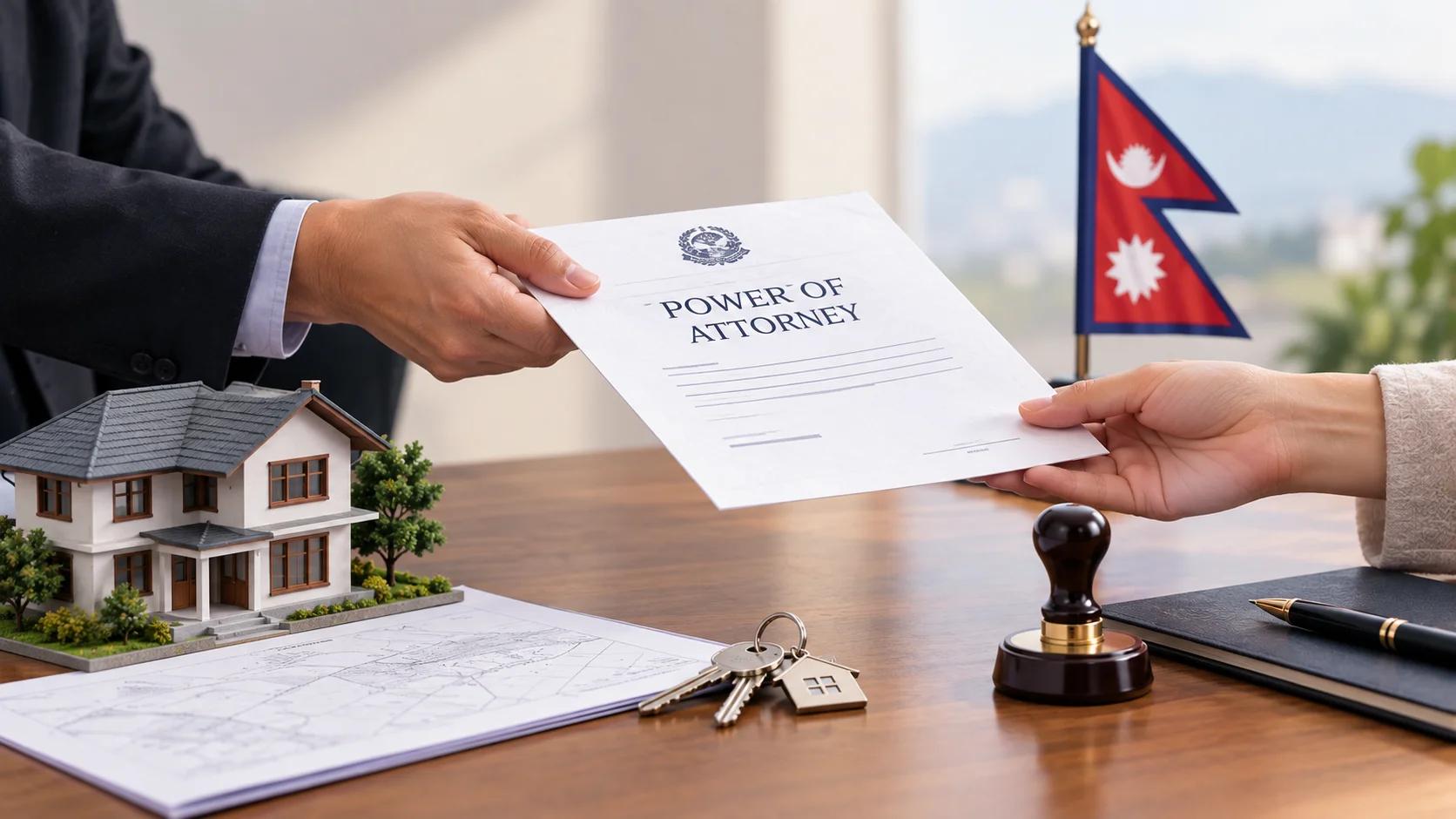
If either party cannot show up in person, you need a notarized power of attorney (Mukhtiyarnama) arranged ahead of time. This matters a lot for Nepalis living abroad. If you are handling a transfer from overseas, see our guide on how to buy a house in Nepal from abroad for the power of attorney details.
How Much Does It Cost? Registration Fees
Both a gift deed and a sale deed carry a registration fee at the Land Revenue Office. The fee is a percentage of the property value. The value used is the higher of the declared price or the government assessed value (Malpot Mulyankan).
As of 2026, the common registration fee rates by area are:
| Location type | Registration fee |
|---|---|
| Metropolitan city | 5% |
| Sub-metropolitan city | 4.5% |
| Municipality | 4% |
| Rural municipality (Gaunpalika) | 2% |
Source: Tax Advisor Nepal and Land Revenue Office practice. These rates are set through provincial finance laws and can change with the annual budget, so confirm the current figure for your area.
Take a simple example. Say a plot in a metropolitan area is valued at NPR 1 crore (NPR 10,000,000). At 5%, the registration fee comes to NPR 500,000. That is the same whether the transfer is a gift or a sale. The registration fee does not disappear just because it is a gift.
One useful point for families. Nepal gives a registration fee concession when property is registered in a woman’s name. The concession is commonly cited at around 25% in urban areas and higher in rural municipalities. If a father is gifting land and can register it in his daughter’s name, the household may pay a smaller fee. Ask your Malpot to confirm the current concession before you plan around it.
What About Capital Gains Tax?

This is where the gift deed really earns its keep. Capital gains tax hits the profit a seller makes on property. On a sale (Rajinama), the seller pays it. On a gift (Bakaspatra) to a close relative, there is no sale price, so there is generally nothing to tax.
The capital gains tax rates changed in the FY 2083/84 budget, which took effect in mid-July 2026. Reporting on the change points to rates in the range of 7.5% and 10% for a resident individual. The lower rate is for property held longer. The higher rate is for property sold quickly. Sources differ on the exact holding-period tiers, so do not treat any single number as final. Check the current rate with the Inland Revenue Department or your Malpot before you sell.
A few things worth remembering:
- Capital gains tax applies to the gain, not the whole price. The gain is the sale price minus your original purchase cost minus allowable expenses.
- A personal residence you have lived in for a long stretch (often cited as more than 10 years) may be exempt from capital gains tax. Confirm the rule that applies to you.
- Gifts between direct blood relatives are the classic way to move property inside a family without triggering capital gains tax.
Be careful with one temptation. Some people dress up a real sale as a gift to dodge the capital gains tax. That is risky. If money quietly changed hands, and the tax office or a disgruntled heir can show it, the deed can be challenged. Use a gift deed when it is truly a gift.
For the fuller picture on selling costs, our breakdown of the property registration process in Nepal walks through the fees and steps in order.
Can You Cancel a Gift Deed Later?
Mostly, no. A gift deed is meant to be permanent. Once the donor has signed, the donee has accepted, and the deed is registered, the donor cannot simply change their mind. The law protects the person who received the gift. You cannot take it back because you had a falling out or found a better plan.
There are narrow exceptions. Section 409 of the Muluki Civil Code, 2074 sets out specific grounds where a court may cancel a registered gift deed. These include:
- The gifted property was actually subject to someone else’s ownership or coparcenary (Ansha) share.
- The gift was made without a legally required consent or approval.
- The donor was legally incompetent, or only partly competent, when making the gift.
- The deed was not executed with the formalities the law requires.
So a gift can be challenged if consent was obtained by fraud, coercion, or undue influence, or if the donor lacked the capacity to understand what they were doing. This last point comes up often with elderly donors who depend on the family member receiving the property. The person asking the court to cancel the gift carries the burden of proof.
A sale deed is even harder to unwind. Once registered, a Rajinama is treated as a completed transaction. This is one more reason to be sure before you sign either document.
Gift Deed vs Sale Deed: Which Should You Choose?
Match the tool to the situation. A short guide:
Choose a gift deed (Bakaspatra) when:
- You are giving property to a close family member and no money is involved.
- You want to plan succession while you are alive and reduce the chance of heirs fighting later.
- You want to avoid capital gains tax on a genuine family transfer.
- You are comfortable that the transfer is final.
Choose a sale deed (Rajinama) when:
- Money is changing hands, at any price.
- The receiver is not a family member.
- You are doing a normal property purchase or sale.
- You need a clean paper trail of a real transaction, for example for a loan or resale later.
One more thing to weigh. A gift deed can affect inheritance. Property that is validly gifted during the donor’s lifetime usually leaves the donor’s estate. So it may not be there for other heirs to divide after death. That is sometimes the goal. Sometimes it is the spark for a dispute. If your family has more than one heir, talk it through and, ideally, get everyone’s understanding on paper. If the property is joint family land, read up on Ansha Banda (property partition) first, because you may not be free to gift the whole thing.
Common Mistakes to Avoid
- Skipping registration. An unregistered gift or sale is not a valid transfer of immovable property. Register at the Malpot.
- Ignoring the relationship proof. Family gifts need a relationship certificate. Missing it causes delays.
- Name mismatches. Even a small spelling difference between documents can stall the whole process. Match names exactly.
- Forgetting the mutation step. After the deed, complete the Naamsari (mutation) so land records update to the new owner.
- Faking a gift to dodge tax. If it is really a sale, treat it as one. A disguised transfer invites challenge.
- Not checking for encumbrances. If a bank loan or a freeze (Roka) sits on the property, clear it before you transfer.
Frequently Asked Questions
Is a gift deed better than a sale deed for transferring property to my child?
For a genuine no-payment transfer to a close relative, a gift deed is usually the better choice. You avoid capital gains tax, and the transfer reflects what is actually happening. You still pay the registration fee at the Land Revenue Office.
Do I pay capital gains tax on a gift deed in Nepal?
Generally no, when the gift is to a direct blood relative, because there is no sale price and no taxable gain. A sale deed, on the other hand, triggers capital gains tax on the seller’s profit. Confirm your specific case, since tax rules change.
What is the difference between Bakaspatra and Rajinama?
Bakaspatra is a gift deed, a transfer with no payment, common within families. Rajinama is a sale deed, a transfer for an agreed price. The presence or absence of money is the core difference, and it changes the tax treatment.
Can a gift deed be cancelled after registration?
Only on narrow legal grounds under Section 409 of the Muluki Civil Code, such as fraud, coercion, lack of the donor’s capacity, or a defect in the required formalities. A court decides. A donor cannot simply revoke a valid gift because they changed their mind.
Who pays the registration fee on a gift deed?
In practice the fee is often paid by the donee, the person receiving the property, but families can arrange this between themselves. The rate depends on where the property sits, from 2% in rural municipalities up to 5% in metropolitan cities.
Can I gift property to someone who is not family?
Yes, the law does not limit gifts to relatives. But the capital gains tax exemption is tied to transfers between close blood relatives. A gift to a non-relative may be treated differently, so get advice before you proceed.
The Bottom Line
The choice between a gift deed and a sale deed comes down to one question. Is money changing hands? If yes, you are doing a Rajinama, and the seller should plan for capital gains tax. If no, and you are passing property to a close family member, a Bakaspatra usually saves tax and reflects reality. Both run through the Land Revenue Office, both need clean paperwork, and both are hard to undo once registered.
Whatever you choose, verify the current fees and tax rates with your local Malpot, and make sure the property is free of loans, freezes, and disputes before you sign. When you are ready to find your next property, or to list one for sale, you can browse verified listings and post your own on Basobaas.
Latest Posts
Fresh reads from Basobaas