How to Estimate the Fair Market Value of Land in Nepal
Ask three people what a plot is worth in Nepal and you will get three answers. The seller quotes one number. The broker quotes another. Your uncle who bought land nearby ten years ago quotes a third. None of them can prove it.
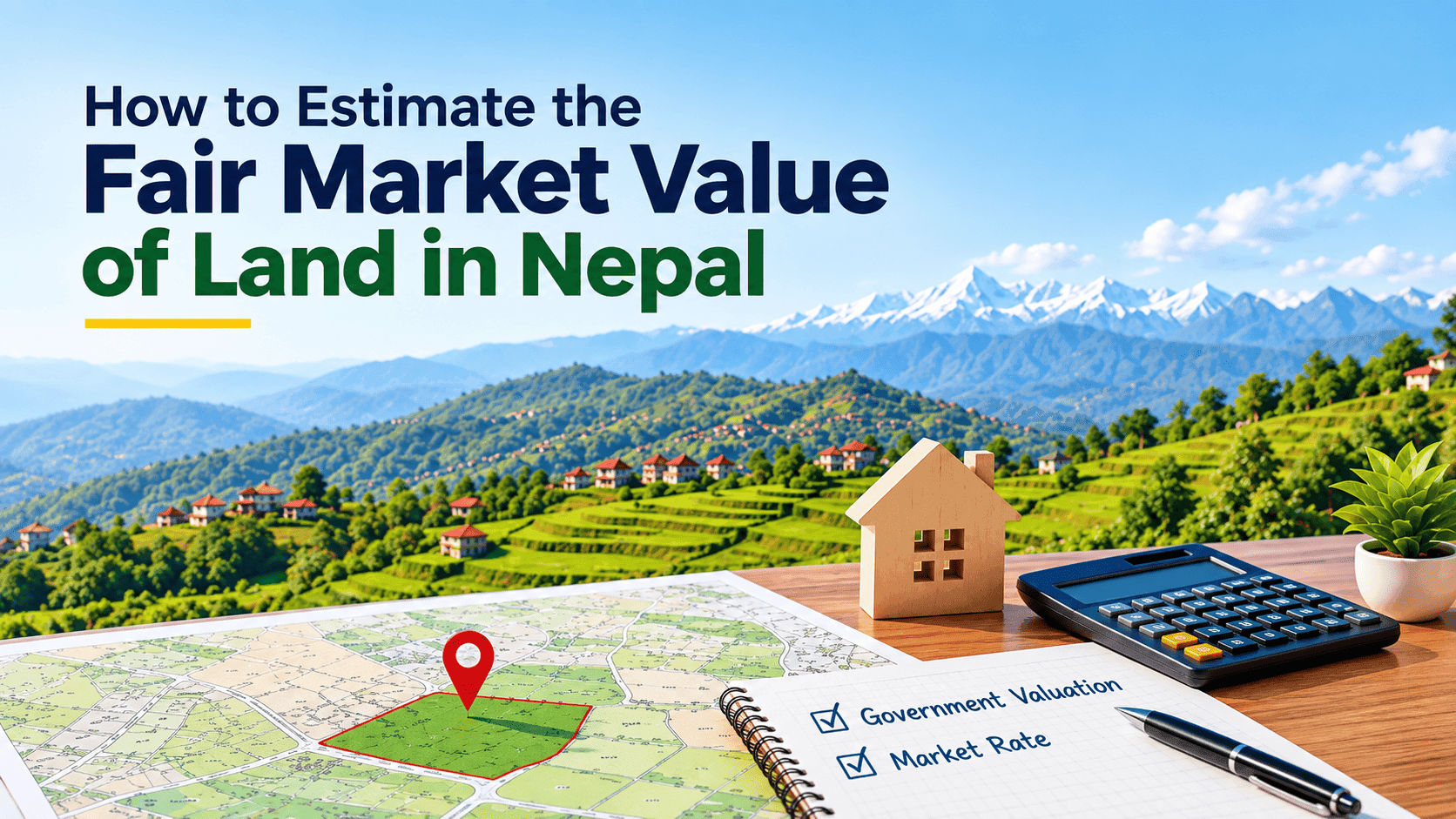
Here is the short version. To estimate the fair market value of land in Nepal, you combine two things. First, the government valuation from the Land Revenue Office (Malpot), which acts as a floor. Second, the market rate, which is what similar plots nearby have actually sold for recently. The real value sits between the government floor and the market comparables, adjusted for road access, plot shape, facing direction, and land use. This guide walks you through each of those.
Quick answer: the fastest way to value a plot

If you only have five minutes, do this:
- Get the government valuation (malpot rate) for that ward and road type from the local Land Revenue Office. This is your minimum reference.
- Find 3 to 5 recent sale prices for similar plots in the same area. Ask local brokers and check listing portals.
- Adjust up or down for road width, facing, and whether the land is residential or agricultural.
- Your fair value is a range, not a single number. Government rate is the floor. Recent comparable sales set the ceiling.
For context, the median land price in Kathmandu Valley in early 2026 was about NPR 38.5 lakh per aana. That was down roughly 22 percent from the 2023 peak of around NPR 49.5 lakh per aana. The figures come from Nepal Rastra Bank real estate data and market trackers. Prices vary hugely by location, so treat that only as a rough anchor.
Government valuation vs market value: know the difference
These are two separate numbers, and people mix them up all the time.
The government valuation is called the malpot rate or sarkari mulyankan. Each fiscal year, a district-level Minimum Price Determination Committee, headed by the Chief District Officer, sets a minimum per-aana value for every ward and road type. These rates are published and enforced across the Land Revenue Offices nationwide. When you register a transfer, Malpot charges the registration fee (around 4 percent for most buyers) on the higher of your declared price or this minimum rate. So the government valuation matters for tax and registration, not for what the land is really worth.
The market value is the bazar bhau. It is the price a willing buyer and a willing seller actually agree on. It reflects demand, supply, road access, and how developed the area is. This is the number you negotiate.
In most peripheral areas and Terai districts, the market price runs 2 to 4 times the government valuation. In premium central Kathmandu, the gap has narrowed. Malpot offices there have pushed government rates up aggressively since 2080 BS, so in some core zones like Putalisadak the two numbers are now close. Knowing both keeps you from overpaying and from underselling.
One practical takeaway. Never assume the government rate is the market rate. On the cheap end, they can trap you into underselling. On the premium end, in central Kathmandu, the government rate can actually sit above real demand right now.
The three methods professionals use to value land
Licensed valuers in Nepal, the ones banks hire when you apply for a loan, lean on three standard approaches. You can use simplified versions of the first one yourself.
1. The comparison method (most useful for you)
This is the workhorse for land. You find recently sold plots that are similar to yours and adjust for the differences. Similar means same area, similar size, similar road access, and the same land classification.
Say plots on your street sold for NPR 30 lakh, 32 lakh, and 28 lakh per aana in the past year. Your plot is comparable but sits on a wider road. You might land near the top of that band, so roughly NPR 33 to 35 lakh per aana. That is the comparison method in plain terms.
The catch is finding honest comparables. Declared registration values are often understated to reduce tax, so the official record may read low. Broker quotes may read high. Cross-check several sources and weight the ones you trust.
2. The cost method
Here you value the land plus the cost of rebuilding any structure on it at today’s prices, minus depreciation. This suits new houses or unusual properties where comparable sales are thin. For raw land, the cost method is less relevant, since there is nothing to rebuild.
3. The income method
This one values a property by the rent it can earn. It fits income-generating property like rental buildings, shops, and hotels. For a bare plot you plan to build on, it matters less, though it becomes relevant if you are buying land to develop and rent out.
When a bank sends a valuer for your loan, they often blend the government rate and the market rate. A common approach is to weight the value at roughly 30 percent government valuation and 70 percent market value . That gives a conservative figure the bank is comfortable lending against, which is usually lower than the price you actually pay.
What actually moves land value in Nepal

Two plots on the same street can differ by lakhs per aana. These are the factors that explain the gap.
Road access and width. This is the single biggest driver after location. A plot on a 20-foot road is worth far more than the same plot on a 6-foot lane. Building permits also depend on it. Most municipalities require a minimum road width, often around 5 meters, and Kathmandu Metropolitan asks for more in many zones. Land with a path too narrow for a permit is worth a fraction of road-access land.
Facing and orientation. South-facing and east-facing plots usually command a premium in Nepal, partly for sunlight and partly for vastu preferences. A north-facing plot may sell for less even with everything else equal.
Land use classification. Agricultural land (krishi jagga) cannot be built on until it is converted to residential, and conversion costs time and money. So agricultural land sells below residential land nearby. Always confirm the classification on the lalpurja before you value it as buildable.
Plot shape and frontage. A regular, rectangular plot with good road frontage is easier to build on and worth more than an odd-shaped or landlocked one of the same area.
FAR and zoning. The floor area ratio the municipality allows sets how much you can build. Higher permitted FAR raises value, especially for commercial plots.
Surroundings and services. Developed neighbors, water supply, drainage, and proximity to a paved road all lift the price. A plot surrounded by empty fields sells for less than one in a built-up colony.
A worked example
Let us value a plot. It is 4 aana in an area of Lalitpur where the government valuation is NPR 21.5 lakh per aana.
Start with the floor. Government value is 4 aana times NPR 21.5 lakh, so NPR 86 lakh. That is the tax base, not the market value.
Now the comparables. Recent sales of similar 4 aana plots nearby ran NPR 28 to 35 lakh per aana. Your plot sits on an 18-foot road and faces east, both pluses. So you sit toward the top, say NPR 33 lakh per aana. That puts the fair market value near NPR 1.32 crore.
The gap tells the story. The government value is NPR 86 lakh. The realistic market value is around NPR 1.32 crore. If a seller quotes NPR 1.6 crore, you now have the numbers to push back. If someone offers you NPR 90 lakh, you know not to sell.
Where to get the numbers
Government valuation. Visit the local Land Revenue Office (Malpot Karyalaya) for the ward, or ask a lawyer or broker who works that area. The rates are published yearly.
Market comparables. Talk to several local brokers, not one. Check listing portals for asking prices, and remember asking prices sit above final sale prices. Ask neighbors what recent plots actually sold for.
Professional valuation. For a loan, a legal case, or a high-value purchase, hire a registered valuer. Under Nepal’s valuation rules, only certified valuers can produce an official valuation used for legal and financial purposes. Expect to pay a fee, but you get a defensible number.
Unit conversion. Prices are quoted per aana in the hills and per kattha or dhur in the Terai. Make sure you compare like with like. One ropani equals 16 aana, or 5,476 square feet. One aana equals 342.25 square feet. Basobaas has a land unit converter if you need to switch between systems.
Common mistakes when valuing land
A few errors show up again and again.
Treating the government rate as the market rate. It almost never is, and the gap runs both ways depending on the area.
Trusting a single broker. Brokers earn on the deal. Get several opinions and weigh them.
Ignoring road width. People fall for a cheap price per aana and miss that the plot cannot get a building permit.
Comparing across land types. An agricultural plot and a residential plot on the same road are not the same asset. Adjust for classification.
Forgetting the market moved. Nepal’s land market corrected 20 to 50 percent in parts of the Valley between 2023 and 2025 after Nepal Rastra Bank raised rates and capped real estate lending. A 2022 price is not a 2026 price.
A quick note on timing the market
Land prices are not fixed. After the 2021 to 2022 boom, tighter bank lending pulled speculative money out, and prices in the Valley fell before stabilizing in 2026. The market today is more driven by real buyers than by speculation. Nobody can tell you exactly where prices go next. Treat any forecast, including optimistic broker talk, with caution. Value the plot on today’s comparables, not on hoped-for appreciation.
Frequently asked questions
How do I find the government valuation of a plot in Nepal? Go to the local Land Revenue Office (Malpot Karyalaya) for that ward, or ask a lawyer or broker who works the area. The district sets and publishes a minimum per-aana rate for each ward and road type every fiscal year.
Is the government valuation the same as market value? No. The government valuation is a minimum used to calculate registration fees and capital gains tax. Market value is what buyers and sellers actually agree on. In most areas the market price is higher, often 2 to 4 times the government rate, though in premium central Kathmandu the two have moved close.
How much does a professional land valuation cost in Nepal? It depends on the plot and the valuer. Banks include a valuation as part of the loan process. For an independent registered valuation, expect a professional fee. A boundary survey by a licensed surveyor is separate and often runs a few thousand rupees depending on plot size and district.
Why do two plots on the same street have different prices? Road width, facing direction, plot shape, land use classification, and whether the area around it is developed all change the price. A wider road and a south or east facing plot usually sell higher.
Can I value agricultural land as residential land? Not directly. Agricultural land (krishi jagga) is worth less than residential land until it is legally converted, which takes municipality approval, time, and money. Confirm the classification on the lalpurja before valuing it as buildable.
What is the fastest way to sanity-check a quoted price? Compare it against the government rate as a floor and against 3 to 5 recent nearby sales as a guide. If the quote sits far above both, ask why. If it sits below, you may have found a deal or a problem to investigate.
Before you buy or sell
Valuing land well is really about doing your homework. Get the government rate, gather honest comparables, adjust for the plot’s real features, and never rely on a single opinion. The number you land on should be a defensible range, not a guess.
When you are ready, browse current listings and compare per-aana prices across areas on Basobaas. It also helps to read our step-by-step guide to buying land in Nepal and our walkthrough of the property registration process before you sign anything. Knowing the numbers turns a stressful negotiation into a fair one.
Latest Posts
Fresh reads from Basobaas