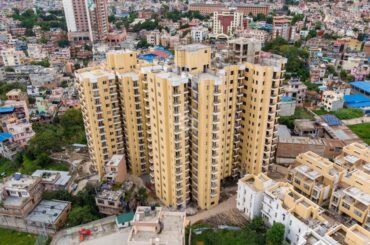

Nepal’s real estate market has its own vocabulary—a mix of Nepali legal terms, government office names, land measurement units, and industry jargon that can be bewildering for first-time buyers, renters, and sellers. This glossary explains 60 of the most essential terms you will encounter when buying, selling, or renting property in Nepal, in plain and simple language.
Why You Need This Glossary
Misunderstanding a key term in a property transaction can be costly. Knowing what a Kitta number is, understanding the difference between an Amsha Patta and a standard Lalpurja, or grasping what “Rajinama” means—these are not optional pieces of knowledge for anyone engaging seriously with Nepal’s property market. Consider this your essential reference guide.
A–D Terms
Aana: A unit of land measurement used in Nepal’s hilly regions. 1 ropani = 16 aana; 1 aana = 4 paisa = 16 daam.
Abadi: Land classification for settled/residential land. Abadi land can be built upon for housing.
Ansh: Government or public land—cannot be privately owned or transacted.
Ansha Patta: A joint ownership document issued when land is divided among heirs. Each heir receives an Amsha Patta specifying their share.
Bainapatra: A preliminary sale agreement (advance deed) signed between buyer and seller before the final registration. Legally binding; includes deposit, price, and timeline.
Bigha: A land measurement unit used primarily in Nepal’s Terai (plains) region. 1 bigha = 20 kattha = 400 dhur. Equivalent to approximately 6,773 square metres.
Chaklaband: A land consolidation process that restructures fragmented parcels into more usable plots.
Dhur: The smallest standard land unit in Nepal’s Terai. 1 dhur ≈ 16.93 square metres.
E–L Terms
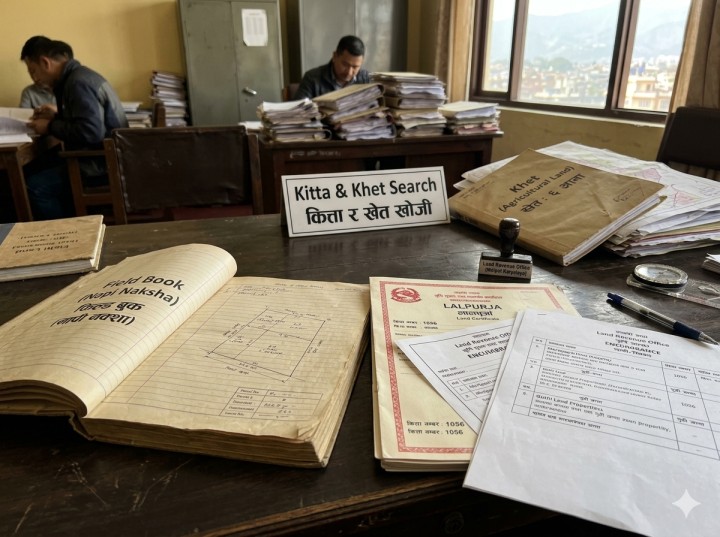
Encumbrance: Any registered claim, loan, mortgage, or legal restriction on a property. An encumbrance search reveals all registered encumbrances.
Field Book (Napi Naksha): The official government survey map showing a land parcel’s boundaries, area, and adjoining parcels. Maintained by the Survey Department.
Guthi Land: Land owned by traditional Newari religious or social institutions (Guthi). Subject to special legal provisions.
Khet: Agricultural land classification, typically lowland paddy fields. Development is restricted on Khet land.
Kitta Number: The unique parcel identifier assigned to each registered land plot in Nepal. This number links the physical land to its Lalpurja and all official records.
Lalpurja: Nepal’s official land ownership certificate. The most critical document in any property transaction.
Land Revenue Office (Malpot Karyalaya): The government office where property ownership is registered and transferred. All legal property transactions must be recorded here.
M–P Terms
Malpot Mulyankan: The government’s assessed value of property for registration fee calculation purposes. Usually lower than actual market value.
Napi Surveyor: A licensed land surveyor registered with Nepal’s Survey Department. Only licensed Napi Surveyors can conduct official boundary surveys.
Occupancy Certificate: A certificate issued by the local municipality confirming that a building has been inspected and is approved for occupation. Critical for buyers of built properties.
Paisa: A land sub-unit in hilly regions. 1 aana = 4 paisa.
Power of Attorney (Adhikar Patra): A legal document authorizing one person to act on behalf of another in property transactions. Must be notarized and current to be valid.
Q–Z Terms
Rajinama: The formal deed of transfer executed at the Land Revenue Office when property changes hands. Signing the Rajinama is the legal act of transferring ownership.
Ropani: The primary land measurement unit in Nepal’s hilly regions. 1 ropani = 508.72 square metres = 16 aana.
Stampnishedha: A legal freeze on a property preventing any transaction while a dispute is being resolved.
TIN/PAN: Tax Identification Number/Permanent Account Number. Required for property transactions above a certain value threshold.
Transfer Deed: The formal legal document recording the transfer of property ownership, executed at the Land Revenue Office.
Nepal-Specific Terms Buyers Often Confuse
Bari vs. Khet: Bari is upland dry field; Khet is lowland paddy field. Both are agricultural classifications with development restrictions, but Bari land is more commonly converted for residential use.
Lalpurja vs. Bainapatra: The Lalpurja is the ownership certificate; the Bainapatra is the preliminary agreement. Signing a Bainapatra does not give you ownership—only a registered Lalpurja does.
Ropani vs. Kattha: Ropani is the hill region standard; Kattha is the Terai standard. These are completely different measurement systems and should never be confused.
Now that you know the language, start your property journey: Explore properties on Basobaas or ask our experts any questions.