The 2015 Gorkha earthquake left an indelible mark on Nepal’s consciousness about building safety. More than a decade later, earthquake resilience has become one of the most important—and yet still frequently overlooked—factors in property purchasing decisions. Nepal sits on the boundary of the Indian and Eurasian tectonic plates, making it one of the world’s most seismically active regions. Understanding what makes a building earthquake-resistant is not just about property value—it is a fundamental safety issue for you and your family.
Nepal’s Seismic Risk Overview
Nepal’s Central Seismic Belt runs directly through the Kathmandu Valley, making the capital one of the highest-risk urban areas in the world for earthquake damage. Historical records show major earthquakes striking Nepal every 75–100 years on average, though smaller events occur regularly. The 2015 earthquake (magnitude 7.8) killed nearly 9,000 people and destroyed or damaged over 600,000 structures. The building stock rebuilt since 2015 is significantly safer—but a large proportion of older buildings remain potentially vulnerable.
Nepal Building Codes and Post-2015 Standards
Nepal adopted the National Building Code (NBC) in the 1990s, but enforcement was minimal before 2015. After the earthquake, enforcement has strengthened significantly—particularly in Kathmandu Valley municipalities—and obtaining building permits now requires structural design review. Buildings constructed or substantially renovated after 2016 under proper permits are generally built to significantly better seismic standards than pre-2015 stock. However, enforcement varies by municipality and unregulated construction still occurs in some areas.
What Makes a Building Earthquake-Resistant
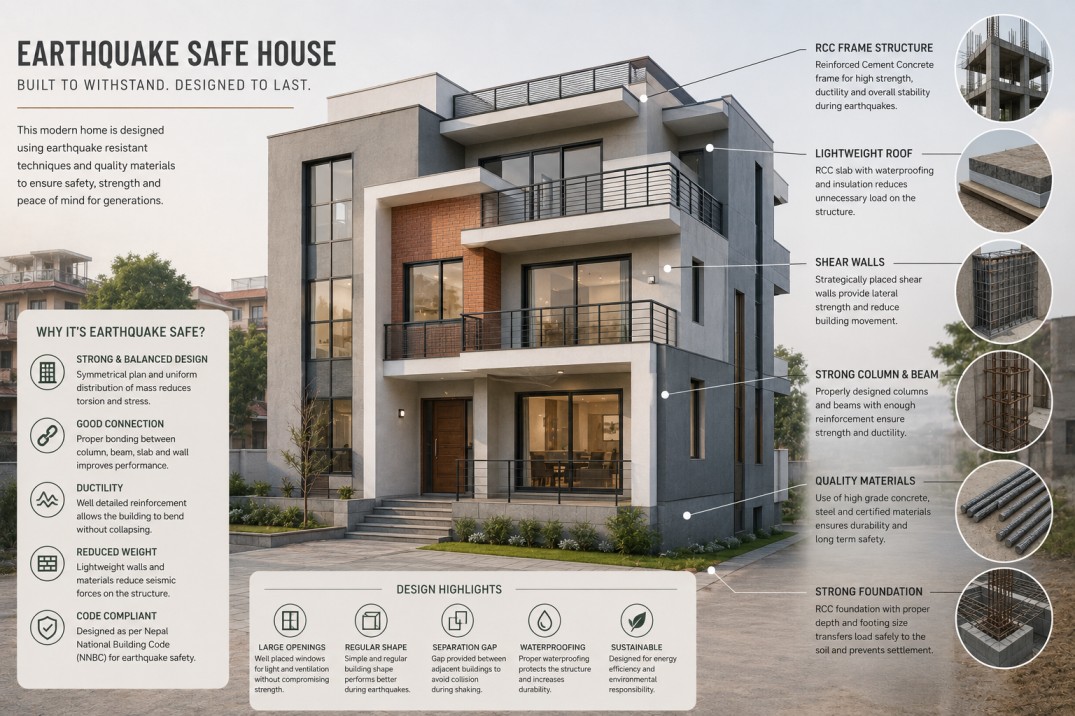
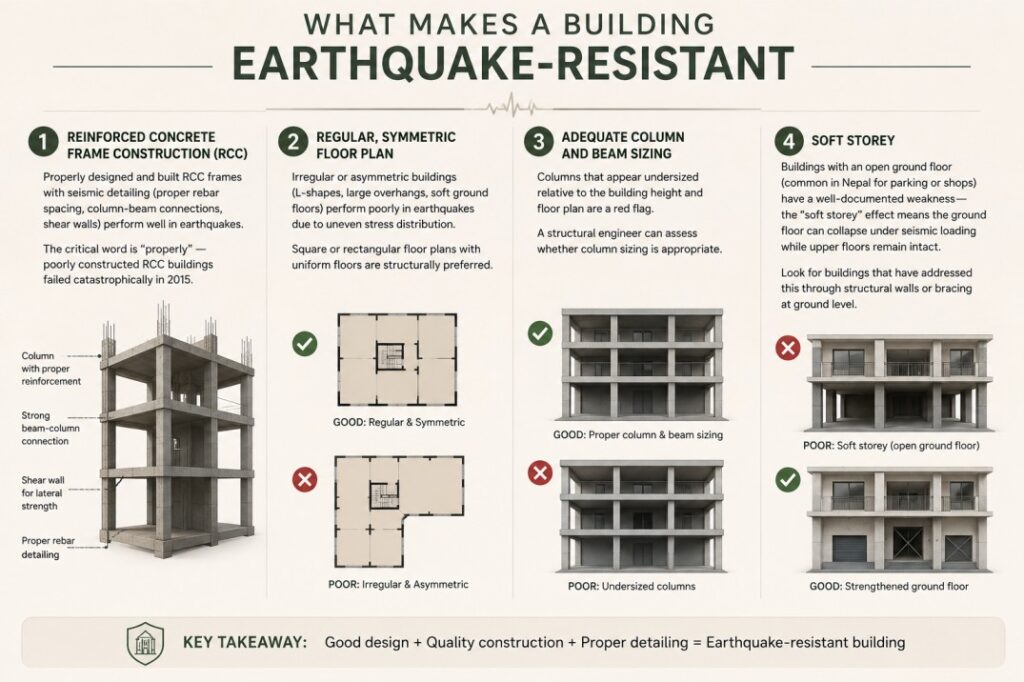
Reinforced Concrete Frame Construction (RCC): The most common modern construction type in Nepal’s urban areas. Properly designed and built RCC frames with seismic detailing (appropriate rebar spacing, column-beam connections, shear walls) perform well in earthquakes. The critical word is “properly”—poorly constructed RCC buildings failed catastrophically in 2015.
Regular, Symmetric Floor Plan: Irregular or asymmetric buildings (L-shapes, buildings with large overhangs, soft ground floors) perform poorly in earthquakes due to uneven stress distribution. Square or rectangular floor plans with uniform floors are structurally preferred.
Adequate Column and Beam Sizing: Columns that appear undersized relative to the building height and floor plan are a red flag. A structural engineer can assess whether column sizing is appropriate.
Soft Storey: Buildings with an open ground floor (common in Nepal for parking or shops) have a well-documented weakness—the “soft storey” effect means the ground floor can collapse under seismic loading while upper floors remain intact. Look for buildings that have addressed this through structural walls or bracing at ground level.
Red Flags in Property Listings
- No occupancy certificate (building not inspected by municipality)
- Construction predating 2015 with no subsequent structural assessment or retrofit
- Visible structural cracks (especially diagonal cracks on walls or columns)
- Open ground floor (soft storey) without structural compensations
- Very thin columns relative to building height
- Brick infill walls with no structural frame
- Building on soft soil or former river bed (amplifies seismic shaking)
Questions to Ask Sellers
When buying any property in Nepal, ask: Does the building have a valid occupancy certificate? Was the building designed by a licensed structural engineer? Has the building undergone a post-2015 seismic assessment? Are structural drawings available for review? Has any retrofitting work been done on older structures?
Working with Verified Builders
One of the safest ways to ensure seismic quality is to buy from developers with a track record of code-compliant construction. Basobaas vets listings and can advise on developers who consistently deliver properly engineered buildings.
Find earthquake-compliant properties across Nepal on Basobaas—our team helps buyers assess building quality during the search process.